Last updated 2026-08-19
TL;DR
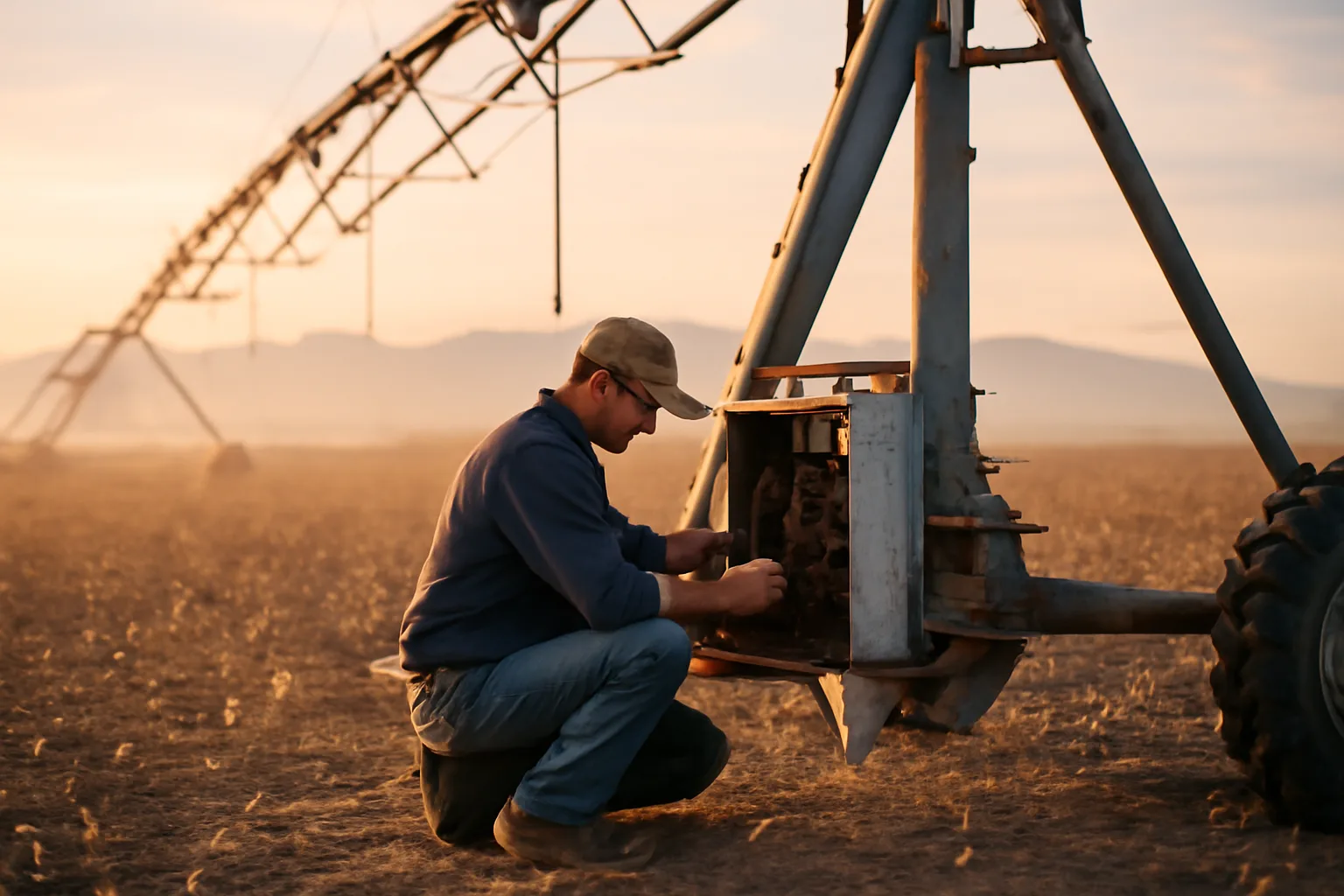
Most Arizona center pivot repairs run from a few hundred dollars for nozzles or a tire to several thousand for a gearbox or span. Labor follows farm-equipment mechanic wages plus rural travel. Owners fixing their own machines usually skip a contractor license. Anyone bidding repair for hire should read Title 32, Chapter 10 and confirm the class with the Registrar of Contractors. Parts lead time often beats wrench time.
How much does center pivot repair cost in Arizona?
Most center pivot repair Arizona bills land in a wide band. A nozzle pack, a bad solenoid, or one tire can stay in the low hundreds. A tower gearbox, a center drive, a collector ring, or a span section jumps into the thousands once parts and travel stack up. Nobody publishes a public Arizona rate card for this work. The closest honest method is to price parts at dealer cost, add shop labor built from published mechanic wages, then add miles.
Labor is the part you can pin to a government table. The Bureau of Labor Statistics tracks farm equipment mechanics and service technicians under SOC 49-3041 and posts national and Arizona estimates on the Occupational Employment and Wage Statistics pages [5][6]. Those figures are wages, not shop rates. A shop that covers a truck, insurance, and a parts room will bill well above the mechanic's paycheck. If a quote looks like the BLS wage with no overhead, something is missing.
Parts are messier. Desert heat cooks rubber boots, tower tires, and grease. Hard water scales nozzles. Monsoon wind walks machines out of alignment. I treat any single number you see on a forum as a story, not a bid. Get the part number off the gearbox tag. Price it from two dealers. Then decide.
Travel is not a footnote here. A tech rolling from Casa Grande to a field west of Gila Bend can burn half a day before a wrench turns. Ask whether the quote is portal to portal. Ask whether Saturday monsoon call-outs carry a multiplier. I would rather see a plain trip fee than a vague “service call.”
A full machine replacement is a different conversation from a repair. NRCS Conservation Practice Standard 442 describes what a sprinkler system is supposed to do when someone designs or rebuilds one, not what your local shop charges to change a worm gear [13]. Use it if you are arguing with a cost-share file. Do not use it as an invoice.
What line items show up on a real Arizona pivot invoice?
A clean invoice names the machine, the span or tower, the part numbers, labor hours, and miles. Fuzzy invoices hide the job. I walk away from “service pivot” as a single line.
Here is the shape of common work. These are field ranges I would use to sanity-check a bid, not a survey and not a promise. Arizona dealers set their own parts books. Confirm the number on the quote in your hand.
| Job | Parts you usually see | Time on site | What I watch |
|---|---|---|---|
| Nozzles, regulators, a dropped span hose | tens to low hundreds | 1 to 3 hours | nozzle chart vs crop |
| Flat tower tire or bad wheel gear | low hundreds | 2 to 4 hours | recap vs new |
| Tower box, contactor, or alignment switch | low to mid hundreds | 2 to 5 hours | heat-soaked wiring |
| Collector ring or slip-ring kit | hundreds to over a thousand | half a day | dust tracking |
| Tower gearbox or center drive | often well into four figures | half a day to a long day | used core vs new |
| Span or pipeline leak that needs a section | thousands | one to three days | rust at the flange |
Sales tax sits on parts in most towns. Arizona's state transaction privilege tax rate is 5.6 percent under A.R.S. § 42-5010, and cities pile local rates on top [10][11]. Confirm the combined rate for the yard that ships the part, not the field pin.
If the invoice capitalizes a new span as an improvement, your tax treatment changes. That is a later section. For now, make the shop split parts and labor. You cannot argue a warranty or a Schedule F line if everything is one lump.
Do you need a license for center pivot repair in Arizona?
It depends who is holding the wrench and whether the job is construction or equipment service. Arizona does not hand out a card titled “center pivot tech.” The paper that matters is the contractor chapter, plus ordinary business licenses.
A.R.S. § 32-1101 defines a contractor as a person who undertakes to construct, alter, repair, add to, or improve a structure, project, or improvement, among other acts [1]. A pivot bolted to a concrete pad can look like an improvement. A gearbox swapped like a tractor part can look like equipment service. That gray line is why you confirm with the Registrar of Contractors instead of a Facebook group.
Owners working their own ground sit in a different pile. A.R.S. § 32-1121 lists exemptions, including owners who improve their own property and a small-project path when the aggregate contract price, including labor and materials, is less than one thousand dollars [2]. Arizona Revised Statutes § 32-1121 sets a one thousand dollar aggregate contract price exemption for some unlicensed work. Read the full exemption list. It is picky about employees, rentals, and what counts as one undertaking.
If you bid repair for hire above that line, acting without a license is not a shrug. A.R.S. § 32-1151 states, “It is unlawful for any person, firm, partnership, corporation, association or other organization, or a combination of any of them, to engage in the business of, submit a bid or respond to a request for qualification or a request for proposals for construction services as, act or offer to act in the capacity of or purport to have the capacity of a contractor without having the contractor's license” in the person's own name [3]. That is the statute, not a blog rule.
License class is the next fight. Arizona Administrative Code Title 4, Chapter 9 sets residential and commercial classifications [4]. Electrical work on drive towers often points people at an electrical class. Pipeline and structure talk points some reviewers at general engineering. I will not pick your class for you. The board will. Dual work is common on pivots. Dual licensing or a properly subcontracted electrician is how careful shops stay out of a complaint file.
Farmers fixing their own machine almost never need an ROC card for that act. Hiring out a rebuild on a commercial farm is where people get sloppy. Confirm the class and the dollar trigger with the Registrar before you print door magnets.
How long does center pivot repair take in Arizona?
Wrench time is usually hours. Calendar time is often days. The gap is parts and distance.
A dropped drop hose or a burned contactor can be same-day if the part is on the truck. A tower gearbox is a half day once the unit is on the tailgate, and a week if the ratio on the tag is a unicorn. Span steel is worse. You wait on a truck from a regional warehouse, then you wait on a calm morning so the crew is not hanging pipe in a 25 mile-per-hour dust wind.
In-season jobs run longer because the machine is in a crop and the field is wet. Winter yard work is faster. I schedule alignment and collector rings in the off months on purpose. June call-outs cost more because everyone else called first.
Lead time is the honest variable. Nobody has a statewide parts clock you can cite. Valley, Zimmatic, Reinke, and T-L dealers in the low desert stock the wear items. Odd-year spans and obsolete panels ship. Ask for the warehouse, not a vibe. If a shop cannot tell you whether the part is in Yuma or on a back order, they do not know the job length either.
Electrical troubleshooting can eat a day even when the part is a $40 switch. Heat-soaked insulation and rodent nests in tower boxes lie. Budget diagnostic hours separately so a “quick look” does not turn into a surprise.
What paper do you need in the first year if you start repairing pivots?
Treat this as a business, not a toolbox. The useful stack is an entity, a transaction privilege tax license, city or county privilege tax if the yard sits inside a town, unemployment and workers' compensation accounts if you have people, and an ROC license if your work is contractor work.
Form an LLC or corporation with the Arizona Corporation Commission if you want the liability split. Articles of Organization are a filed form, not a vibe. Confirm the current form and fee on the Commission site before you mail anything. Processing time is whatever the Commission is doing that week. I will not invent it [14].
Arizona Department of Revenue issues the TPT license that lets you collect tax on parts and on contracting classifications that fall under TPT [11]. Cities add their own privilege tax. The state rate is the 5.6 percent figure in A.R.S. § 42-5010. Local add-ons change by town [10]. Confirm the combined rate for your shop address.
If you hire, the Industrial Commission of Arizona is the workers' compensation conversation and the minimum-wage conversation. Arizona's minimum wage is set each year on the Industrial Commission page. Confirm the current dollar amount before you write an offer letter [12]. The Department of Economic Security handles unemployment insurance for employers. Do not skip it because “it is just my cousin in the truck.”
ROC paper, if you need it, is its own pile: application, classification, exam if required, bond or equivalent, and recovery fund items the board lists. Fees move. Confirm them on the board's fee page. I will not invent a current ROC fee.
A paper checklist helps when you are new and the boards all want different PDFs. ValleyRepairPath publishes a $179 one-time Valley/Zimmatic Parts Kit aimed at that filing stack, and the start path is /start if you want the kit. The article still works if you never click it. Print the statute and the board pages either way.
ValleyRepairPath is an independent publisher, not a law firm and not a service company. Nothing here is a license grant.
What fails first on Arizona pivots in desert heat?
Rubber and grease fail first. Then electrical contacts. Then alignment. Pipe is last unless someone hit it with a tractor.
Tower tires cook on bare ground in June. Boot seals on gearboxes harden and weep. Collector rings load up with dust and start dropping a phase, which is how you fry a motor you did not plan to buy. I would rather replace a ring kit in January than explain a string of dead tower motors in July.
Water quality is the quiet killer. Colorado River and groundwater mixes in the AMAs leave scale. Nozzles drift off chart. You think you have a pressure problem. You have a mineral problem. Pull three nozzles off the outer span and look before you buy a new pump impeller.
Wind walks end towers. After a monsoon cell, check the last two towers before you blame the alignment board. A bent link is cheaper than a control panel.
None of this is a peer-reviewed failure study. It is how desert machines age. If you want a design baseline rather than a war story, NRCS 442 is the sprinkler practice standard, and the 2022 Census of Agriculture is where Arizona's irrigated farm counts live [13][9].
When should you repair, rebuild, or park the machine?
Repair when the rest of the machine has life and the water right still pencils. Rebuild when several towers are tired and you can still park the machine for a week. Park it when the field is about to lose water.
Arizona's Active Management Areas and Colorado River reductions have already taken acres out. The 2022 Census of Agriculture is the official place to see how many Arizona farms still irrigate and how many acres sit under sprinklers [9]. I will not invent this year's acre count. Read the state tables. If your district just cut you, a four-figure gearbox on a 20-year machine is a gift to the scrap yard.
Tax treatment matters on the rebuild call. IRS Publication 225, the Farmer's Tax Guide, treats ordinary repairs as current expenses and treats replacements that add value or prolong life as capital items [7]. The publication says you can generally deduct the costs of repairs that keep property in a normal operating condition, and it draws a line against improvements. Your CPA picks the line on a new span. I would not.
I would get three quotes on any gearbox or center drive. Paying rush freight on a no-name box with a soft input shaft is a waste. Paying a dealer to pad hours because you did not pull the ratio tag is also a waste. Photo the tag. Send it.
How do labor, travel, and after-hours rates work out here?
Start from the wage tables, then be honest about overhead. BLS posts Arizona estimates next to the national 49-3041 profile [5][6]. Electricians (SOC 47-2111) show up on the same Arizona OEWS page if the job is a panel, not a seal. Those are still wages.
Rural travel dominates the bill more than the hourly number. I like a stated loaded hourly rate plus a mileage or trip fee. I do not like “two hour minimum” when the shop is 90 minutes away and they already billed the drive. Ask. Put it in the work order.
After-hours is real in July. Crops do not wait. A night multiplier is fair if it is written. A surprise multiplier on the invoice is how shops lose the next farm over.
Shop rate vs farm rate is a fight I will not fake a study for. There is no Arizona official pivot-tech wage. Use BLS, add truck and insurance, and compare two written quotes. If you are pricing center pivot repair cost in California or center pivot repair cost in Colorado against an Arizona bid, remember those states have different wage floors and different drive times. The part may be the same. The truck is not.
What taxes, insurance, and safety rules sit on the job?
Tax on parts is TPT plus city. Contracting classifications can pull TPT on the labor too, depending how the board and DOR read the job [10][11]. Confirm with DOR. Do not copy a New Mexico invoice and hope.
If you have employees, workers' compensation is not optional theater. The Industrial Commission is the agency. Minimum wage is the same house [12]. General liability is not a statute I can quote into existence, but a dropped span on a county road will make you care. I would not run a service truck on a personal auto policy and a prayer.
Safety on a live machine is federal. OSHA 29 CFR 1928.57 covers guarding and servicing of farm field equipment. The rule says, “At the time of initial assignment and at least annually thereafter, the employer shall instruct every employee in the safe operation and servicing of all covered equipment with which he is or will be involved” [8]. Lock out the pivot. Chock it. Do not service a moving tower because the grower is in a hurry.
Pivot electrical can kill you in wet soil. If you are not the electrician, stop at the tower box and call one. That is not softness. That is how people stay alive in irrigation.
How do Arizona costs compare with other states?
Parts catalogs look similar across the West. Labor and travel do not. Arizona's long dirt miles and summer heat add time you may not see in a compact Eastern service area. Compare the method, not a single Facebook number.
If you want the same cost-and-paper treatment for other states, read the Alabama, Arkansas, Idaho, Georgia, Illinois, and Florida writeups. Licensing thresholds change by state. So do sales tax and contractor boards. Do not carry an Arizona ROC story into a state that uses a different dollar trigger.
Water is the Arizona-only twist. A cheap repair on a machine that will not have a pumping allocation next year is not cheap. Read the Census irrigation tables and your district's current allocation letter before you authorize steel [9].
What would I do this week if a gearbox locked up?
Pull the ratio and input type off the tag. Photo it. Call two dealers with that number, not “a Valley box on tower four.” Ask on-hand vs freight. Ask core charge. Ask seal kit vs whole unit.
If the rest of the machine is tired and the water is shaky, stop. Price a used gearbox against a parked field. If the machine is sound, I would rather wait two days for the right ratio than hang a wrong box and cook the next tower motor.
Write the work order with hours, miles, and tax called out. If the shop is bidding as a contractor, ask for the ROC license number and class. You can look it up. If they bristle, that is data.
For first-year operators still assembling forms, confirm every fee with the board that collects it. If you want the kit path, it is /start. Either way, print A.R.S. Title 32, Chapter 10 and the current TPT rate table and keep them in the truck [1][2][3][11].
Frequently asked questions
How much does center pivot repair cost in Arizona?
Small jobs such as nozzles, a tire, or a contactor often stay in the low hundreds of dollars. Gearboxes, center drives, collector rings, and span steel commonly land in the thousands once parts and travel are included. There is no official Arizona price list. Build the bid from dealer parts, BLS-based labor, and miles, then get a second quote.
Do you need a license for center pivot repair in Arizona?
Owners repairing their own machines usually rely on the owner exemptions in A.R.S. § 32-1121. Someone bidding repair for hire can fall under the contractor definition in A.R.S. § 32-1101, especially above the one thousand dollar aggregate price exemption. Confirm the classification with the Arizona Registrar of Contractors. Do not guess from a forum.
How long does center pivot repair take in Arizona?
Many wear-item jobs finish the same day if the part is on the truck. Gearboxes and electrical hunts often take a half day to a day of wrench time. Span work can run one to three days. Parts freight and wet fields stretch the calendar more than the labor hours. Ask the warehouse location when you book the job.
Does a farmer need an ROC license to fix their own pivot?
Usually no, if they own the property and do the work themselves or with their own employees under the owner provisions in A.R.S. § 32-1121. Selling that same repair to a neighbor can flip the job into contractor territory. Read the exemption list. Confirm edge cases with the Registrar, not with a parts counter.
What contractor class covers center pivot work in Arizona?
Arizona has no pivot-only card. Electrical tower work often maps to an electrical classification. Structure and pipeline talk can pull general engineering. Arizona Administrative Code Title 4, Chapter 9 lists the classes. Dual work is common. Confirm with the board before you advertise both wiring and steel.
Is the one thousand dollar exemption a free pass?
No. A.R.S. § 32-1121 describes a small-project exemption when the aggregate contract price, including labor and materials, is less than one thousand dollars, and it sits next to other exemptions with their own limits. Splitting invoices to stay under the line is how people get complaints. Read the whole section.
Do I pay Arizona transaction privilege tax on pivot parts?
In most cases yes, at the state rate of 5.6 percent under A.R.S. § 42-5010 plus city and county add-ons. Some contracting classifications also pull TPT on labor. Confirm the combined rate for the shop address on the Department of Revenue rate tables. Do not copy a rate from a different town.
Can I deduct a gearbox on my farm return?
Ordinary repairs that keep property in normal operating condition are generally current expenses in IRS Publication 225. Replacements that add value or prolong life can be capital improvements. A new span is more likely capital than a seal kit. Have your tax preparer read Pub 225 against the invoice lines. I am not your CPA.
What first-year filings does a new Arizona repair shop need?
Typical stack: an entity with the Corporation Commission, a TPT license with DOR, local privilege tax if you are inside a city, unemployment with DES if you have staff, workers' compensation through the Industrial Commission system, and an ROC license if the work is contracting. Confirm every current fee with the board that collects it. No one should invent those numbers for you.
What safety rule applies when we service a running pivot?
Do not service it running. OSHA 29 CFR 1928.57 requires instruction at initial assignment and at least annually on safe operation and servicing of covered farm field equipment. Lock out power, chock towers, and treat wet soil plus 480 volts as a killing combination. Annual toolbox talk is the floor, not a suggestion.
Why are Arizona pivot repairs so travel-heavy?
Fields sit a long way from the dealer yards that stock gearboxes and span steel. A tech can burn half a day on dirt roads before the first bolt turns. Written trip fees beat vague service-call lines. Compare that pattern with closer-in states before you call an Arizona bid padded.
Should I rebuild a pivot if my water allocation just got cut?
Price the water first. A sound gearbox on a field that will not get a pumping allocation is scrap with extra steps. Use your district letter and the 2022 Census irrigation tables for context, then decide. I would not hang new steel on a machine whose acres are leaving the map.
Sources
- Arizona Legislature, A.R.S. § 32-1101 Definitions: Defines contractor to include persons who undertake to construct, alter, repair, add to, or improve a structure, project, development, or improvement.
- Arizona Legislature, A.R.S. § 32-1121 Exemptions: Lists contractor-license exemptions, including certain owners improving their own property and a small-project exemption when the aggregate contract price is less than one thousand dollars.
- Arizona Legislature, A.R.S. § 32-1151 Acting without license: Makes it unlawful to engage in the business of, bid as, or act as a contractor without a contractor's license in the person's own name.
- Arizona Secretary of State, Arizona Administrative Code Title 4 Chapter 9: Sets Registrar of Contractors rules and residential and commercial license classifications used to match electrical and engineering work.
- U.S. Bureau of Labor Statistics, OEWS 49-3041 Farm Equipment Mechanics and Service Technicians: Publishes employment and wage estimates for farm equipment mechanics, the occupation that prices pivot shop labor.
- U.S. Bureau of Labor Statistics, Arizona Occupational Employment and Wage Statistics: Publishes Arizona-specific wage estimates, including farm equipment mechanics and electricians.
- Internal Revenue Service, Publication 225 Farmer's Tax Guide: Explains when farm repair and maintenance costs are current deductions versus capital improvements.
- OSHA, 29 CFR 1928.57 Guarding of farm field equipment: Requires employers to instruct employees at initial assignment and at least annually in safe operation and servicing of covered farm field equipment.
- USDA NASS, 2022 Census of Agriculture Arizona state volume: Reports Arizona state tables on farms, irrigated acres, and irrigation methods including sprinklers.
- Arizona Legislature, A.R.S. § 42-5010 Rates of tax: Sets Arizona's state transaction privilege tax rate at 5.6 percent.
- Industrial Commission of Arizona, Labor minimum wage page: Publishes Arizona's current minimum wage, which shops must confirm before staffing.